Final stop, Washington

After nearly three weeks on the road from Juneau to Seattle, we are back in the states and with full access to the cyber world. We did our best to document the incredible Canadian landscape we crossed over, the people we met, and the places we stopped at along the way in order to share our experience with friends, family, and whoever else cares to look into our road lives or is interested in the sort of trip we took. We traveled a diverse landscape and found some of the most incredible places we’d ever seen. We don’t have enough hands to count the number of times I said “I like it here.” In a short time, I’ll be starting work in Seattle and Lara will be off to wherever her wanderlust takes her, probably crewing some ship somewhere awesome or paddling rivers wherever. Click on the links below to read about our trip and see some pictures!

Part One: The Klondike

Part Two: Stewart-Cassiar

Border Crossings

Part Three: The National Parks of the Canadian Rockies

Part Four: Stoked on BC

Part Five: Close to Home Now in the Sea to Sky Corridor

e4d39c39c80dd824c7ff9bbde1cdb791

Sea and Sky

As we headed south from Whistler area, the landscape already started to feel like home. Now, the places I’d be driving through until Seattle would be a part of my extended backyard. When I caught first glimpse of the Chief, I had to hang up the phone with my mother just so I could focus on it. As a climber, it was exciting to finally see it. The Chief is a great granite fortress that overlooks the town of Squamish. It is the crown jewel of big wall climbing in the region. In fact, it is probably the most well know climbing destination in Canada–and for good reason.

Highlights: Looking at the Chief and knowing one day I will be on it. SQUAMISH. Climbing in Cheakamus Canyon. Visiting Whistler. Bypassing Vancouver. Easy Border Crossing! The entire Sea to Sky Corridor.

To inspire me

Last fall I had the pleasure of hosting two of my climbing heroes, David Roberts and Ed Ward, at Hampshire College where they presented some slides of their incredible first ascent of Shot Tower via the West Ridge. Seats in the lecture hall were filled as expected and conversation carried on at the High Horse Brewery in downtown Amherst. These guys crush. In 71′, after Hampshire’s inaugural year, they took a group of Hampshire students all the way from Western Massachusetts up the AlCan Highway to Bettles where they took a bush plane into Alaska’s rugged interior, the Brooks Range. They taught good judgement and the rudiments of climbing on the virgin granite of the Arrigetch and claimed several first ascents–Disneyland, Badile, and a beautiful 16 pitch spire called Shot Tower. The slides were so crisp–they are

seared in my mind. Their trip was adventurous, courageous–full of risk and exposure. Although, Dave jokingly admits that the most dangerous thing they did “was let the Hampshire students drive that van to Alaska.”  The trip set the foundation for a strong Hampshire climbing legacy. Many others  have followed and continue to follow the ambitions of Dave and Ed with the same spirit and enthusiasm. People like Jon Krakauer, Pete Ward (founder of NE2C), Pete Clark, Earl and Glenna Alderson and a coalition of dedicated climbers come to mind.

Shot Tower is etched in my mind. I fantasize about climbing the iconic route in 2021, the 50th anniversary of Dave and Ed’s first ascent, to raise money for the Hampshire Outdoor Program. You can read about the 1971 trip into the Brooks Range in Dave’s book, On the Ridge Between Life and Death.

Ed Ward on crux pitch of Shot Tower


Moving a camp on ice

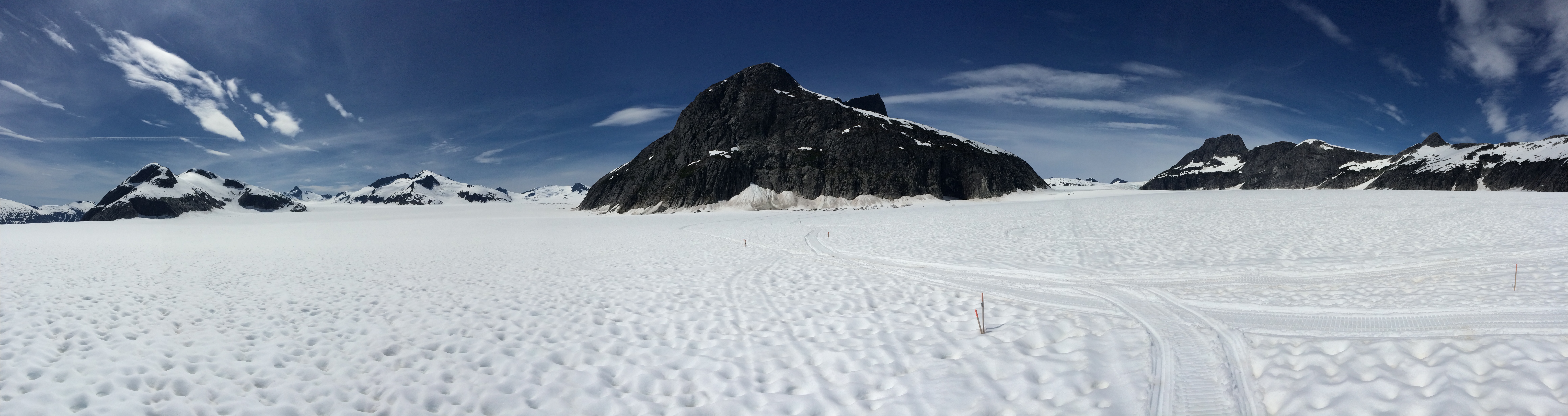
Maintaining a remote glacier camp isn’t easy. When long days of summer heat, persistent rain, the warmth of 183 dogs and a busy camp melt away the previous winter’s snowfall to a thousand foot layer of glacier ice, it is essential to move further up glacier where snow is more abundant. Why wouldn’t we just start where there is more snow? The further up glacier our camp sits, the more likely we will experience poor weather, thus fewer opportunities to offer tours.

Since our initial camp at the base of a towering peak with the name “The Guardian”, we have moved our entire operation twice–both moves vastly different than the other. Our first move was all hands on deck–our entire team of twenty, along with the support of two pilots and their A-Star helicopters. In probably one of Juneau’s hottest summer days, we moved 65,000 pounds of stuff, dogs and all, 6 miles to our “Howling Huskies” camp up the middle branch of the Norris Glacier. Several trips and about thirteen quick hours later, we were settled into our new camp between two massive hanging glaciers on either side of us, and a granite peak whose form is reminiscent of two howling huskies.

After about a month at “Howling Huskies”, we knew we’d move again, but when the decision to do so was made, it was without any warning. Not only was this camp sitting on just two feet of snow, but water was beginning to seep up from the glacier, forming pools of water throughout the kennel. So after a full day of working and waiting for the weather to clear for tours, we ate an early dinner around 6:00 and began moving everything. Although we only moved a little over a mile, we had just three snow machines (the Alaskan way to say snowmobile), half our crew, and a full day of work already behind us.

Instead of loading dogs into helicopters, we took teams of 14-16 dogs directly to the new camp, where we unhooked them and introduced them to their new homes. Unlike Camp Move #1, rain hardly let up, it was dark enough to see the light of distant snow machines between camps, and it was cold–the Alaska I had imagined and expected. But we finished in a just under four hours. If we had gone any later I’m not sure I’d have been able to function for morning tours. But by 11:00 I was in my sleeping bag with the propane heater on high, drying out myself and my clothes. And without any weather canceling, we began a regular day of tours at 8:30–after a hot breakfast of course.

I live at a place referred to as “dog world”

Image

We begin to hear the whump-whump-whump of the helicopters before they crest the final ridgeline before camp. To us, the sound means “it’s go-time.” In a second, the copters are just barely visible dots coming into the valley, and in a few more, they are on the snow with travelers from all over the world. From a distance, their smiles break any language barrier. From their perspective in the helicopter, the sound of slowing rotor blades drown out the 180 howling huskies before them, all eager to run.

“Welcome to Dog World,” we say as we greet visitors and take their safety fanny packs. After directing them to the opposite side of the helicopter, we juggle their fancy cameras to get their photos while talking small talk—“Where are you from?”, “Is this your first time to Alaska?”, “Have you ever been on a glacier before?”, “Do you have a dog?” et cetera ad nausium. But in that brief amount of time I get with them before they take their tour with our mushers, I am reminded at how amazing it is to be in a place like this for the first time.

As I flew over that last ridgeline and caught my first glimpse of my summer home on the Norris Glacier, I could still hardly believe it. It was even more amazing than I had imagined from the video (see below). The camp, the dogs, the people—the whole operation collectively referred to as Dog World was as foreign as the moon. In the evening, I saw my co-workers eyes for the first time which were hidden throughout the day by glacier glasses, their shape outlined by suntanned skin.

Throughout a day of tours I am constantly reminded that I have the best job in the world. I’ll believe that. It is pretty awesome. But what is even more satisfying is the chance I get to be a part of so many people’s “life changing experiences.” For them, it is the trip of a lifetime, a major check off a bucket list, or whatever other way they categorize the experience.

For a better idea of what our operation is all about, check out the Alaska Heli-Mush promo video (It may have been a reason I chose to work at a sled dog tour kennel for the summer to begin with)

Northwest to Alaska

IMG_5569Like previous summers, I threw my essentials into the car and drove west towards the mountains. This time, my compass pointed towards even bigger mountains–always bigger mountains is the trend. Alaska. 4000 miles, 15 states, and one speeding ticket later, I am situated in my temporary home base for the summer on Douglas Island, a walk over the bridge from Alaska’s state capital, Juneau.

Sometime back in the fall I got the idea in my head that I’d drive to Alaska for a summer job. At the time, I could hardly take the thought seriously. But after a few interviews, I took a job with Alaska Heli-Mush, a high end sled dog tour kennel on the Norris Glacier in the Juneau Icefield. So I hit the road with my good friend, Faraday. The long drive to work gave me a lot of time to think about what to do without Hampshire College on the fall horizon. The new freedom is exciting, but also overwhelming. I ended the trip with more questions than I started with, but also explored some philosophical territory that provided insight into them all.

So we took to the road, stopping at some of the most beautiful places we had ever seen. But even better than the scenery, were the people we met along the way. We spent our first evening with our friend Martin and his family outside of Detroit. They gave us a place to stay and some good food to eat after a long day of driving. I even got to sing some Polish Christmas songs with his mom (don’t ask) and saw Martin make a pretend machine gun out of his oversized fur-ball cat, Celka.

As we got further from home, the conversations we made with others from familiar eastern states provided much comfort in the new landscapes we were experiencing. Simply being from the eastern states was enough to start a conversation, even if the distance was from Massachusetts to Washington D.C. or even Florida. There was the Sinclair family. We met them at the Liard Hot Springs in northern British Columbia during their trip up the Alcan from eastern Massachusetts to Anchorage, Alaska. They had both just retired and were taking up residence in the great state of Alaska. From just our short parking lot conversation, I was offered a place to stay if I ever passed through Anchorage.

And the transient look into the lives of those who lived elsewhere in the vast North American countryside, whether through simple observation or engaged conversation, proved that we have more in common than not despite our physical distance.  I had learned that truth in Steinbeck’s Travels with Charley: “Americans are more American than Northerners, Southerners, Westerners or Easterners . . . California Chinese, Boston Irish, Wisconsin Germans, and yes, Alabama Negroes, have more in common than they have apart . . . It is a fact that Americans from all sections and of all racial extractions are more alike than the Welsh are like the English, the Lancashire man like the Cockney, or for that matter the Lowland Scot is like the Highlander.”

After spending some meditative alone time in the hot springs, I began talking to some folks from Edmonton, Alberta about the Athabasca tar sands, the dirty extraction process, and our energy future. I learned that they were on the road traveling to Dawson City, Yukon for a friend’s funeral, adding more friends and family to their caravan as they made their trek north. Unlike most others traveling the AlCan, they, like ourselves, were not RV-ers. Just a sidenote–despite being on the road with so many RV-ers, we hardly made any conversation with any of them. They mostly found other RV-ers to talk to about RV stuff. From Liard to Whitehorse, Yukon, we ran into our Edmonton friends 5 times in two days at rest stops and in towns. In Whitehorse, we found them on the side of the river cooking burgers, more friends in tow. By this point, although we didn’t know them by name, we picked up conversation like they were good friends. They offered us some of their food and suggested some good camp spots. They made us feel a whole lot closer to home. All of the friendly strangers did. It was exactly what I needed to experience before starting work far from home.

The trip provided a smooth transition away from college towards “adult life,” plus, Faraday and I were able to get caught up on our favorite podcasts, This American Life and the Dirtbag Diaries.

Trip Highlights: crossing into Canada, Banff and Jasper National Park, seeing many grizzly bears, including a mother and three cubs, several black bears, mountain goats, moose, elk, antelope, bighorn sheep, a Canadian lynx, mule deer, tons of eagles, meeting so many kind people, the Liard Hot Springs, AlCan Highway, traveling through new places, climbing at Bozeman Pass, the Bee’s Knees Hostel and Nancy and Bertha in Whitehorse, crossing into Alaska, Janilyn and the Alaskan Sojourn Hostel, Keith and Brandon (some awesome travelers with some good stories)

Trip Highlights: crossing into Canada, Banff and Jasper National Park, seeing many grizzly bears, including a mother and three cubs, several black bears, mountain goats, moose, elk, antelope, bighorn sheep, a Canadian lynx, mule deer, tons of eagles, meeting so many kind people, the Liard Hot Springs, AlCan Highway, traveling through new places, climbing at Bozeman Pass, the Bee’s Knees Hostel and Nancy and Bertha in Whitehorse, crossing into Alaska, Janilyn and the Alaskan Sojourn Hostel, Keith and Brandon (some awesome travelers with some good stories)

The Best Part of Going is Coming Back

One adventure ends, another begins. Leaving the comfortable home base that Hampshire had provided me the past few years wasn’t easy–the thought of being thousands of miles away from the familiarity of home and the security of friends, family, and a community of people available whenever I needed to get away from studies to climb, run, and explore wasn’t easy. On the eve of my departure Northwest to Alaska, my friend Nick asked me the simple question–“why?” That day and night friends from Hampshire, friends from home, and my family got together to celebrate my graduation and my post collegiate going away travels. I was unsure what the outcome would be in gathering the different groups together. It went better than I could have hoped for which made ‘going’ the next morning an even tougher reality. But despite how great everything was, I told him that I just needed to go. I couldn’t come up with any better response than that… and that “the best part of going to new places is coming back to old places.” I told him that I needed time away from home, from friends, family, and everything else I became used to and comfortable with so that I could better appreciate it all.

And that is how it has been–every summer for the past 6 years I have found somewhere new to go to and everytime I miss everyone and everything from back home more and more as the summers progress. Now though, my concept of home is changing as I create memories and make friendships all over. Going back to those places become equally important and meaningful. Without Hampshire on the fall horizon, I will have the freedom to go farther and for a longer period of time than previously. I’m unsure how the freedom will affect my idea of home, permanence, relationships, but I sure will embrace it. And like usual, I will seek out the familiarities of home wherever I go.