Maintaining a remote glacier camp isn’t easy. When long days of summer heat, persistent rain, the warmth of 183 dogs and a busy camp melt away the previous winter’s snowfall to a thousand foot layer of glacier ice, it is essential to move further up glacier where snow is more abundant. Why wouldn’t we just start where there is more snow? The further up glacier our camp sits, the more likely we will experience poor weather, thus fewer opportunities to offer tours.
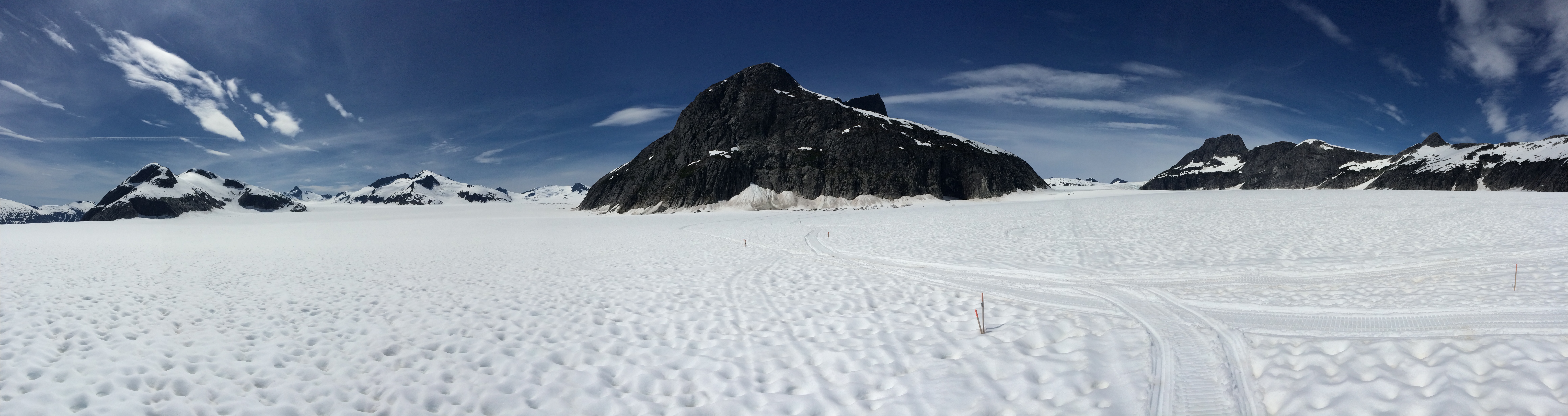
Since our initial camp at the base of a towering peak with the name “The Guardian”, we have moved our entire operation twice–both moves vastly different than the other. Our first move was all hands on deck–our entire team of twenty, along with the support of two pilots and their A-Star helicopters. In probably one of Juneau’s hottest summer days, we moved 65,000 pounds of stuff, dogs and all, 6 miles to our “Howling Huskies” camp up the middle branch of the Norris Glacier. Several trips and about thirteen quick hours later, we were settled into our new camp between two massive hanging glaciers on either side of us, and a granite peak whose form is reminiscent of two howling huskies.
After about a month at “Howling Huskies”, we knew we’d move again, but when the decision to do so was made, it was without any warning. Not only was this camp sitting on just two feet of snow, but water was beginning to seep up from the glacier, forming pools of water throughout the kennel. So after a full day of working and waiting for the weather to clear for tours, we ate an early dinner around 6:00 and began moving everything. Although we only moved a little over a mile, we had just three snow machines (the Alaskan way to say snowmobile), half our crew, and a full day of work already behind us.
Instead of loading dogs into helicopters, we took teams of 14-16 dogs directly to the new camp, where we unhooked them and introduced them to their new homes. Unlike Camp Move #1, rain hardly let up, it was dark enough to see the light of distant snow machines between camps, and it was cold–the Alaska I had imagined and expected. But we finished in a just under four hours. If we had gone any later I’m not sure I’d have been able to function for morning tours. But by 11:00 I was in my sleeping bag with the propane heater on high, drying out myself and my clothes. And without any weather canceling, we began a regular day of tours at 8:30–after a hot breakfast of course.


 Joseph Lawrence Olbrych